

Bochum University of Applied Sciences
DiKomAll - Map Use for People with Cognitive Impairments

The Challenge
As part of the DiKomAll project, the KomMonitor web GIS platform was to be evaluated. KomMonitor is a freely available web application designed to shed light on current issues and key aspects of urban development using a meaningful system of indicators, tailored to specific needs and based on up-to-date geodata and statistics. The initial task was to identify barriers and key challenges in its use.
The study focused on the user-centered further development of the application: map functions and content were to be designed in such a way that they remain understandable and easy to use even for users with lower literacy skills, limited concentration, or uncertainty in handling digital maps.
Typical GIS interfaces work with a multitude of tools, layers, legends, and states. For the target group, this complexity can quickly become a barrier – therefore, interactions should be reduced, terminology simplified, and visual feedback made clearer.

The UX Solution team at con terra thoroughly familiarized themselves with our project and, in collaboration with the target audience, developed tailored recommendations for improving the usability of the KomMonitor.”
The Customer
Bochum University of Applied Sciences is a university of applied sciences focused on the forward-looking fields of technology, business, and health. It offers interdisciplinary degree programs that are socially relevant and grounded in a deep commitment to sustainability.
In the DiKomAll research and transfer project at Bochum University of Applied Sciences, accessible digital participation formats are being developed to more fully involve people with cognitive impairments in municipal planning processes. The goal is to create understandable, usable, and procedurally relevant solutions for an inclusive digital community.
The Solution
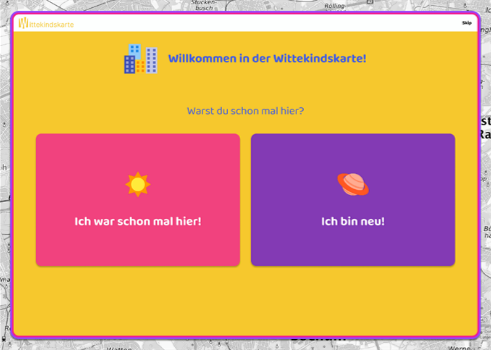
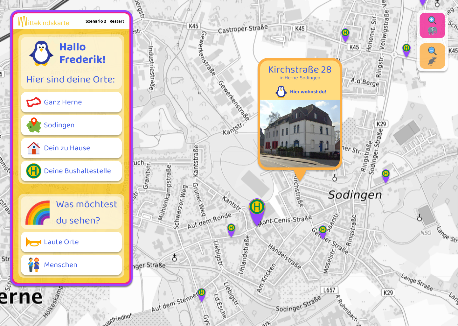
Based on user research and contextual analyses, key barriers such as feeling overwhelmed, uncertainty, and a lack of feedback were identified and translated into two personas and specific user stories. Building on this, con terra developed a UX concept featuring a clear visual hierarchy, large controls, labels instead of abstract icons, and a guided onboarding experience tailored to individual users.
Supplementary guidelines such as limited zoom levels, easy navigation back, and clear markers/pop-ups further enhance orientation, confidence, and usability.
con terra focused on the following components:
- User research and moderated sessions with co-researchers (people with various cognitive impairments) – using simple language and a low-stimulus testing environment.
- Analysis of personas, user stories, and UX guidelines for cognitive relief in map applications.
- Design of the onboarding process, navigation, and map elements (tools, markers, pop-ups, legend), as well as mechanisms for error tolerance and easy reset.
- Creation of a clickable prototype as the basis for the iterative further development of KomMonitor.
Technology and Methodology
KomMonitor (Web GIS)
User-Centered Design / Geo-UX
Moderated Usability Tests
Figma (Clickable Prototype)
The Advantages
The simplified interface and guided onboarding reduce cognitive load: users can orient themselves more quickly, better understand symbols and legends, and confidently interpret maps.
The results are immediately actionable: personas, design guidelines, and prototypes provide a clear foundation for implementing inclusive Geo-UX – from zoom guidelines to clear visual feedback.
Summary
DiKomAll demonstrates how inclusive Geo-UX can make municipal information accessible through the use of maps. Through collaboration with co-researchers and iterative prototyping, a practical foundation was established for the effective use of KomMonitor.